THEORETICAL CONDENSED MATTER · QUANTUM THEORY

The geometry of
quantum matter.

I develop theories connecting quantum geometry to electronic transport, quantum entanglement, and the emergent phases of strongly interacting matter in materials relevant to topological quantum computing.

Principal Investigator on 3 research grants

Alexander Kruchkov
Associate Research Scholar · Princeton University

GEOMETRY → EMERGENT PHYSICS01 / MOIRÉ
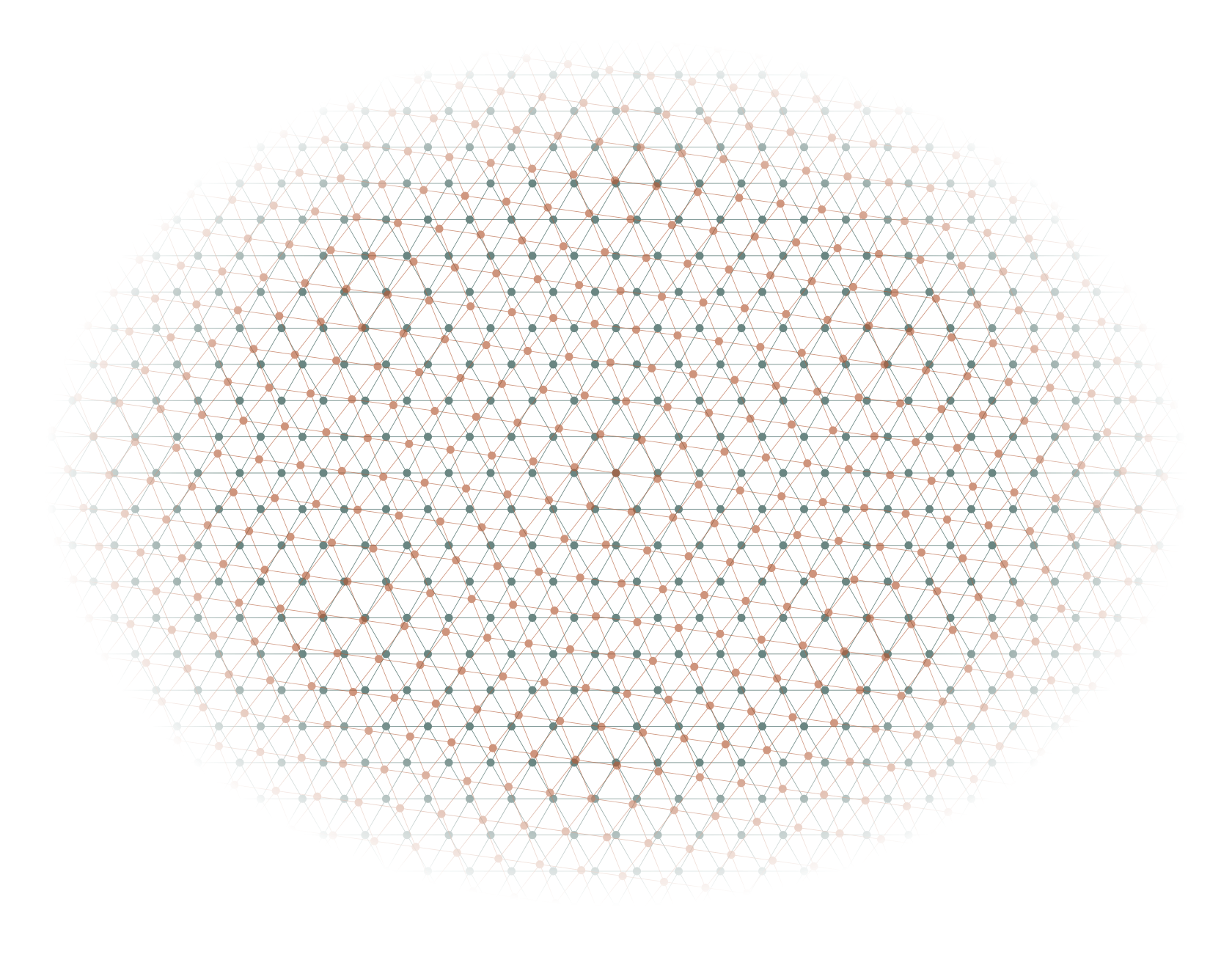
Illustrative interference pattern formed by two rotated lattices
Two lattices.
New possibilities.

Moiré materials feature nontrivial quantum geometry and emergent quantum behavior.

01 / SELECTED WORK

Selected work.

Contributions to interacting quantum matter, quantum geometry, quantum entanglement, and magic-angle graphene.

4 selected papers
2025published

Bounds on entanglement entropy from quantum geometry

Alexander Kruchkov and Shinsei Ryu

Physical Review B 111, L241111

With Shinsei Ryu, relates the quantum metric to spatial entanglement and Chern-number bounds in gapped two-dimensional lattice systems within a Slater-determinant description.

2019published

Origin of Magic Angles in Twisted Bilayer Graphene

Grigory Tarnopolsky, Alexander Kruchkov, and Ashvin Vishwanath

Physical Review Letters 122, 106405

Introduces the Tarnopolsky–Kruchkov–Vishwanath chiral model, now a widely used theoretical framework for magic-angle graphene and correlated flat-band physics. Within this model, vanishing Dirac velocity implies an exactly flat band, revealing analytical structure behind the magic angles.

02 / GRANTS & LEADERSHIP

Principal Investigator.
Three research grants.

I lead funded research on quantum materials, topological quantum computation, and quantum geometry, including collaborations with Titus Neupert and Vincent Fortuin.

Principal Investigator

SNSF · 2025–2028

Swiss National Science Foundation

Quantum materials and entangled phases for topological quantum computing

With Titus Neupert. Project partner: Shinsei Ryu.

View funded project

Principal Investigator

BRANCO WEISS · 2026–2028

Branco Weiss Society in Science

QUANTUM AI: Bayesian optimization for anyonic search for hardware-level fault-tolerant quantum computation

With Vincent Fortuin.

View collaborative program

Principal Investigator

DFG · 2027–2031

German Research Foundation (DFG)

Quantum Geometry: A Pioneering Paradigm in Topological Quantum Matter and Quantum Information Science

Project begins in 2027.

WORKSHOP CO-ORGANIZER

New Twists of Quantum Geometry

December 4–6, 2024

Princeton Center for Theoretical Science · 407 Jadwin Hall · Princeton University

Workshop announcement & program

OrganizersDuncan Haldane, Alexander Kruchkov, Biao Lian, Shinsei Ryu, and Pok Man Tam

Abstract

The workshop connected quantum geometry with measurable properties of quantum matter and methods for experimental testing. It brought theory and experiment into conversation across unconventional superconductivity, fractional quantum Hall and Chern phases, topological flat bands, and moiré systems. Further themes included solid-state and cold-atom measurements, geometry in nonequilibrium settings, and connections to quantum information and mathematical physics.

Summary of the PCTS workshop announcement.

03 / RESEARCH

Geometry as a guide.
Quantum matter as the frontier.

How do the hidden geometric properties of quantum states shape the physics we can measure? My work connects this question to materials, entanglement, and strongly interacting systems.

01

Quantum geometry & flat bands

I derive geometric contributions to electrical and thermoelectric transport in topological flat bands, and connect band flatness to Wannier-orbital structure.

GUIDING QUESTIONHow does current flow when electronic bands become flat?
Read the transport paper
02

Entanglement & topological phases

With Shinsei Ryu, I relate spatial entanglement bounds to the quantum metric in gapped band systems. This informs my broader program on topological phases for quantum information.

GUIDING QUESTIONHow do quantum geometry and topology constrain entanglement?
Read the entanglement paper
03

Strong correlations & quantum transport

With collaborators, I derive identities for interacting Fermi surfaces and develop transport probes of strong correlations, including Sachdev–Ye–Kitaev physics in disordered graphene.

GUIDING QUESTIONWhat can transport and Fermi surfaces reveal about electronic correlations?
Read the SYK paper

RESEARCH DIRECTION

From geometric insight
to quantum materials.

My research program asks how quantum geometry and interactions can help predict and control correlated topological phases, including fractional Chern insulators and candidate platforms for topological quantum computing.

As Principal Investigator, I connect quantum-materials theory with computational searches for anyonic phases through projects with Titus Neupert and Vincent Fortuin. My DFG project, beginning in 2027, extends this program across quantum matter and quantum information.

Related funded projects

04 / TEACHING

From physical intuition
to a working theory.

At EPFL, I taught a doctoral course connecting the physical assumptions of moiré models to their mathematical structure.

In Lectures on twisted bilayer graphene (PHYS-756), I connected continuum models and magic angles to band topology, quantum geometry, Wannier functions, and correlated phases. The course was designed for theorists and experimentalists.

The format combined 21 hours of lectures with 7 hours of exercises, giving students space to work through the theory.

Contact me about teaching materials

EPFL · PHYS-756 · DOCTORAL COURSE

Lectures on twisted bilayer graphene

21 hours of lectures7 hours of exercises2 credits

From moiré band structures to correlated quantum phenomena, designed for theorists and experimentalists.

View course description
Alexander Kruchkov

Alexander Kruchkov

05 / ABOUT

A scientist working
across scales.

I am an Associate Research Scholar in the Department of Physics at Princeton University. My work spans geometric theories of flat bands, entanglement bounds, and transport in strongly interacting electron systems.

I lead an independent research program on the geometric principles of quantum matter, from analytical theories of flat bands to computational searches for anyonic phases. I am Principal Investigator on three research grants connecting quantum materials, quantum geometry, and topological quantum computation.

CV & CONTACT

Let’s talk
quantum matter.

For faculty search inquiries, research collaborations, and teaching inquiries.

Request current CV

Department of Physics
Princeton University